The team could follow the secure coding standards as well as update dependencies and yet, they may have a vulnerability that did not get noticed. Actual attacks do not follow an orderly checklist. An attacker may combine a weak authorization with an unprotected API, misuse a process for reset of passwords, or find out that information from one tenant could be access by a different.
Companies operating in Brisbane make use of penetration testing experts to guarantee security. They evaluate systems through the adversarial lens. Experienced testers don’t ask whether security measures are put in place, but whether they are able to be bypassed.
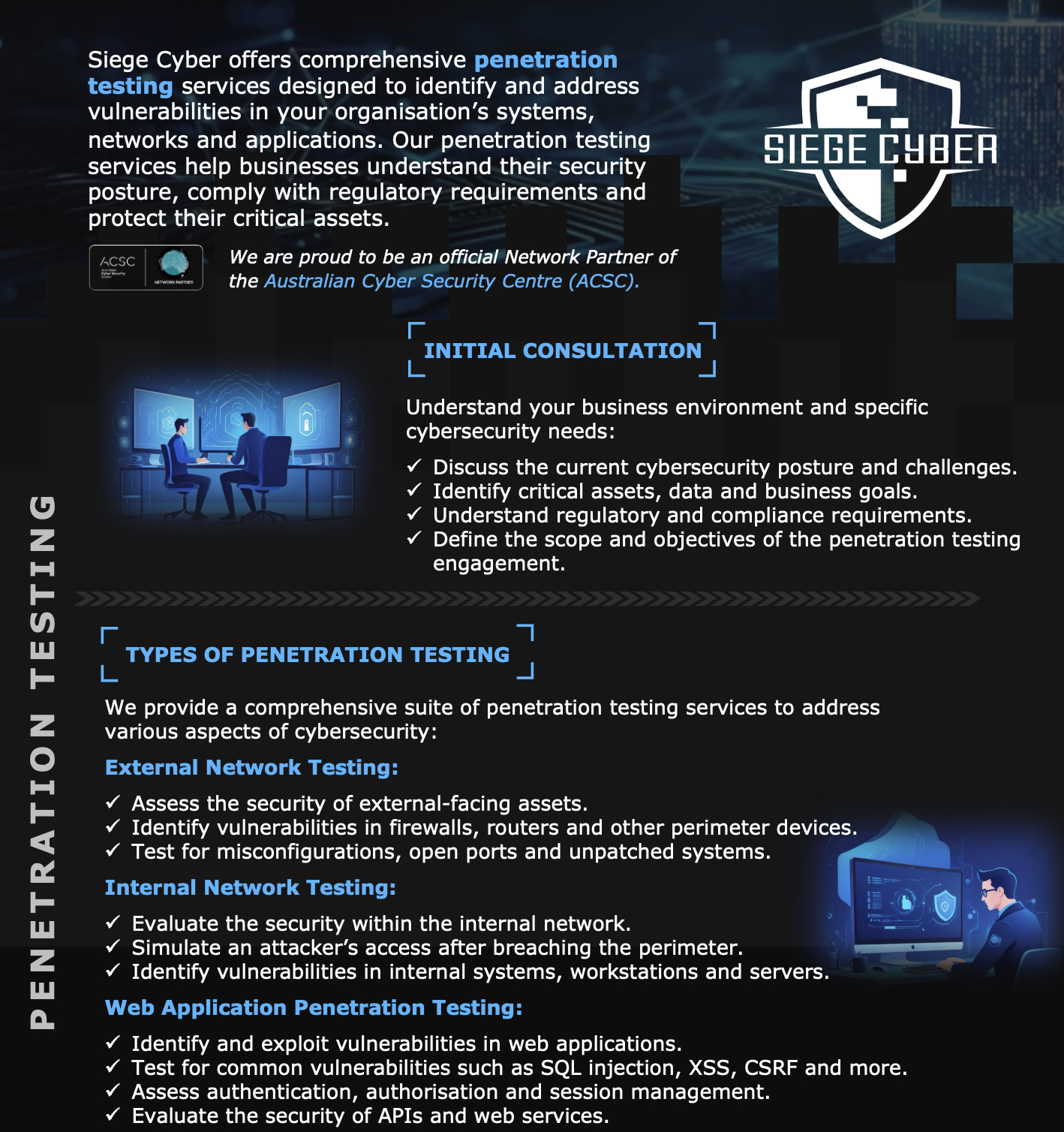
This difference is important to Australian companies that handle sensitive information like customer information as well as financial records, health records, or any other assets.
The automated scanning process is only part of the story.
Vulnerability scanners are extremely useful. They are able to quickly detect outdated code or headers that are insecure (CVEs) that are known to be CVEs, and clear configuration mistakes. They are not able to understand how an application should behave.
Imagine a customer portal that allows users to change their account number with an application, and also retrieve invoices from another company. The server can return perfectly valid responses, so an automated scanner doesn’t see anything unusual. Human testers can detect the error immediately.
Quality web penetration testing combines the automated process with manual analysis. Testers investigate authentication sessions, access control and injection risk, API behavior, configuration weaknesses and business processes, while seeking out combinations of weaknesses that could create meaningful impact.
SaaS environments pose security concerns of their own
Multi-tenant cloud solutions require be tested with care because a mistake can affect many customers simultaneously.
Saas penetration tests should cover tenant isolation as well as privileged functions. Also, it should cover API authorization, role change and account recovery, as well as data leakage, as well as integrations with external services. The tester should not only examine if the feature actually works but also to determine if it is able to be utilized in a way that was not planned by the developer.
A user in a fundamental task, such as may not be able to view administrative functions within the interface. It doesn’t necessarily mean the underlying API does not allow them to call it directly. It is essential to verify the API rather than just observing what appears to be the API.
Modern web applications have a more extensive attack surface
Applications today combine JavaScript front end APIs, cloud services, and APIs. They also include integrations with third-party providers. Any component, or the trust relationship between them, could have weak points.
Thorough web app penetration testing follows those connections. Testers may examine the way tokens are distributed as well as whether the endpoints are able to have a consistent authorization process as well as how data controlled by users moves between applications, and whether the flaw is low-risk and can be paired with another vulnerability to produce a serious compromise.
Siege Cyber is an expert in this kind of testing applications. They utilize modern frameworks such as APIs and cloud-hosted platforms. They also test complex application architectures.
A helpful report could aid developers in resolving the issue
Finding vulnerabilities is just half the work. Security testing can provide the greatest value when engineers can reproduce the problem, comprehend the danger, and fix it confidently.
Siege Cyber reports include evidence, reproduction steps Risk ratings, impact analysis, and practical instructions for resolving the issue. Technical teams get the information required to address the issue while stakeholders from the business receive an executive level description of the risk. It is possible to take action on critical findings during the engagement, rather than waiting for the final reports.
Testing after remediation provides another layer of assurance by confirming that the initial flaw has been addressed without creating a new one.
Penetration testing can be a useful method for organizations trying to test their systems, prove the compliance of their systems or gain more confidence prior to an important release. The policies and tools don’t offer this, but it provides them with a way of discovering how skilled hackers could attack the software. The real value is in identifying the answer before an actual adversary.